If you've been learning foreign language for a while, you probably know the struggle: memorising thousands of vocabularies, hundreds of grammar points, and absorbing a bunch of different cultural nuances makes the language alive--all that trying to share space inside your already-packed busy brain!
I've been learning Japanese for a while now, and there are a lot of things that needs to be memorised, especially since Japanese uses a different writing system I grew up with. It's a lot to digest.
Where I from, we simply use Latin alphabet. Using another writing system is just adding another layer on top of the already difficult things--hiragana? katakana? not to mention thousands of kanji???
Funny thing is, I didn't feel this way when I first started learning English. I just know the language one day and used it, like, it kind of just happened. I learned it sooo passively I didn't even feel like learning at all.
I've been exposed to English media since I was 4 years old or something. I still remember watching cartoon network for the first time and I didn't understand a single thing, I just kind of guessed what the character are saying.
But Japanese? This one is a whole different thing even though I consumed a lot of Japanese media daily. Despite all those exposure, the language just don't want to just slip in to my brain the same way English did hahah
Anyway, I'm not here to talk about the language itself, but more about exploring how to memorise different things!
It doesn't have to be language, it can be applied to literally anything! It just so happens that language learning is one of my favourite topics to talk about recently.
Why we forget: It's not you, it's your brain!
Ever found yourself thinking, "Why do I keep forgetting this?" or maybe the bigger question is: "How does memory actually work? How do we even manage to memorize anything at all?"
I am no brain expert or neuroscientist or anything in that field, so don't expect any paper-worthy answer -- remember, this is just some random guy's blog where he rambles about stuff :)
That being said, I'm not going to give an answer out of thin air, I've been exploring this topic recently. Understanding how memory works could give us some clue on how we memorise things, and maybe figure out how to game the system a bit -- minmaxx the shit out of it.
One thing I found interesting is our brain forget things on purpose, it's not a bug, it's a feature! If anything, it's actually doing you a favour, believe it or not. Imagine if you still remember every cringe moments you had from childhood, that would be a nightmare hahah
To not make myself look like I just talking out of my ass, I'll try to give you some references that you can read later on, these are the ones that I used when writing this post.
- The Biology of Forgetting - A Perspective
- Understanding Memory: How Our Brain Stores and Forgets Information
- Active forgetting and neuropsychiatric diseases
- Project Illuminated
Let's break them down, shall we?
How the brain forgets
There are basically multiple ways the brain can forget things, or at least that's what the researcher have learned so far. It's divided it into 2 groups: Passive Forgetting and Active Forgetting.
Passive Forgetting
This is the most common way the brain forgets things. The brain just forget things it deems no longer needed, the memory just decays overtime.
There is this interesting sentence I found from the paper:
The incidental accumulation across time of similar memory traces that impeded proper retrieval of the wanted one, and changes in the memory's context between acquisition and retrieval that impairs efficient recall
Now that's some proper cognitive psych jargon, but how I understand it is as follows:
-
Too many similar things causes the brain to forget which one is which
Have you ever had those moments where you go "oh yeah it's... wait, which one was it again?" -- I had that a lot, especially with kanji memorisation because a lot of them are similar, see 待つ、持つ、and 時. They mean different things: to wait, to posses, and time.
This is called interference--memories that are too similar piled up and messes up with each other causing you not able to recall them. Ever found yourself in a situation where you name the file
final.docx,final2.docx,istg-this-is-the-final.docx,final-revision.docxor something like that? -
Changes in situation between acquisition and retrieval
The environment of the time you're trying to recall is too different from the one where you were acquiring them, thus making it a context-dependent memory.
For example, you memorise this kanji in a quite environment of your room, but suddenly you have to recall it on a loud public place, you suddenly feels blank.
I guess this is also why if you memorise something, and then try to recall it again on the same environment, it's really easy to do. Like having a memory on certain place with a specific scent, you will instantly recall the memory given that exact situation, because you give the brain some context to help it.
There are a bunch of other Passive Forgetting that the brain can do, but I'm not going to talk about all of them here since it isn't the main focus of this post. Oh, and feel free to correct me :)
Active Forgetting
This is the opposite of passive forgetting. The brain actively forgets things; it actively tries to forget things for several different reasons.
-
Proactive and Retroactive Forgetting
There are 2 types of interference, namely: proactive (before acquisition) where the old memory interfere with the new one, and retroactive (after acquisition) where adding new information causing the old memory harder to recall. For example, memorising new kanji causing you to forget the old one.
The two could accelerate the decay of the memory traces. Our brain has limited space, limited energy, and our biological materials are limited. We can't remember everything so the brain constantly making space.
This one is still unclear on whether it's categorised as active or passive forgetting, at least that's what I found out. There are some research that says it's part of passive forgetting, and there are other research that says it's part of active forgetting.
-
Intentional Memory Suppression of Traumatic Events
It's when you intentionally suppress the memory of something traumatic that you've experienced. It's the brain's coping mechanism, and it's common in cases of trauma. The brain actively works to prevent those memories from resurfacing, it prevents us from recalling those painful experiences.
Have you ever experienced a traumatic event? An accident, a death of a loved one, breaking up with someone, etc. I'm pretty sure we've all been there, and it's painful to remember those events, so we actively try to forget it, even though most of the time it's really hard to do.
It's like when someone said to you "don't think of an elephant" but you immediately imagined an elephant inside your head, even though the instruction clearly said "don't think"--I know you just did ;)
How does the brain remember?
Enough about the brain forgetting, let's talk about how the brain remembers things. The brain has several steps in order for it to remember something.
1. Encoding
Wow, such fancy word, but all it means is that the brain take all the relevant parts, convert it into something that it understands. Pay attention, or it won't stick! Ever had any occurence where you forgot someone's name even though they just said it to you? You don't have a bad memory, you just didn't pay attention, whoops! ;)
2. Consolidation
The brain takes the information and stabilises it. It can take some time and can also happen when you sleep. The brain sort of reactivates the memories and rehearses them to itself, so that it remembers!
3. Storage
The brain stores the information in a way that it can be retrieved later. Without going to deep, the brain basically weighs the memories and put relation / connection between them. It's like a graph, where the more you remember, the stronger the connection between the memories. They are not stored in a single place, rather, they're spread out across different regions.
The storage are split into 2 parts, the short-term memory--also known as primary or active memory--and the long-term memory.
-
Short-term memory is where the brain stores the information for a short period of time. Researchers believe that it is accessed sequentially, which is why you can recall the fifth number on your phone number only running through the first few digits.
It can only hold limited amount of information, basically what you're thinking right now. We can turn it into a long-term memory if we make an effort for it, such as repetition.
-
Long-term memory holds stuff for days, years, and sometimes indefinitely! Even crazier, it can potentially stores an unlimited amount of memory, with some researchers questioning if we ever forget anything!
When you 'forget' something, the memory is still probably there, you just can't find it right now. Our brain contains around 86 billion neurons, and each of those neurons form about a thousand connections with other neurons. Do the math and you'll get more than a trillion connections! It's been estimated to be around 2.5 petabytes (2.5 million gigabytes), more than enough to store everything that has happened to your life :)
Unlike short-term memory, these are not in order. You find them by linking them to various things: feelings, sights, scents, sounds, anything that happens to be in your environment when the memory was made.
When the memory gets recalled, it goes through a reconsolidation process, during which can alter the memory given there are similar informations to the one being recalled. Therefore, our memories are not infallible or always reliable.
4. Retrieval
When you want to recall the information, the brain will try to find the best match. It's like a search engine, it will look for the most similar memories and return the one that matches the most. But sometimes, it just fails. It's not because the memory doesn't exists, it's just that the brain fails to recall. Hence why you sometimes don't remember your colleague's name but suddenly out of nowhere their name pop up in your mind :)
If you want to read more in detail, I recommend you to check out this article:
How to stop your brain from ghosting you
If you don't want your brain to ghost you, you need to stop it from doing so by reviewing it just before it forgets. If only there was a way to do that... Kinda like how you charge your phone, you do it when it's low in battery, just before it dies.
Most people just re-read stuff randomly. But what if you could figure out the exact best moment to review? The one that gives you the most bang for your buck, think of it like minmaxxing your brain.
Well, lucky enough for us, people figured it out already! You can totally minmax your memory, it's called Spaced Repetition System!
Explain like I'm five?
So, what is Spaced Repetition System and how does it actually work? Okay, so, imagine this scenario:
>be you
>learning a new language, new skills, new concepts, whatever
>cramming it all in, feels good for a moment, feels like you achieved something
>wake up the next morning, poof, half of it is gone
>feelsbadman.png
>thinking you're not actually learning anything,
>stopped learning because you don't feel motivated anymore
Listen, it's not your fault. Our brain just works like that. Totally fine! You can't expect to instantly remember everything you just learned in a day.
But... what if I tell you that there is a way to fight that forgetting curve? Here's where Spaced Repetition System comes in! Check out this famous Herman Ebbinghaus curve.
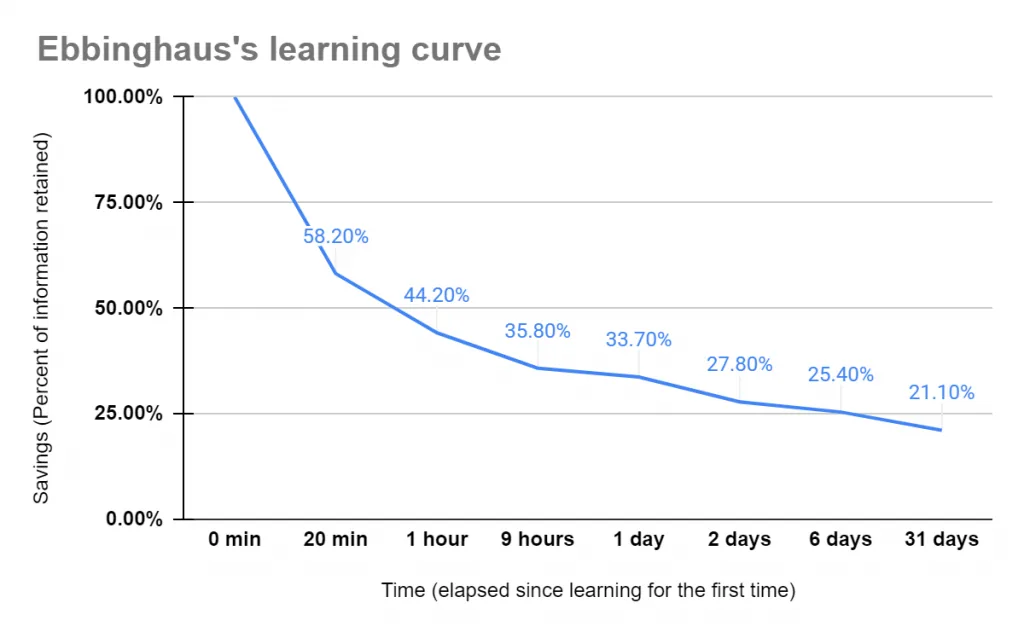
Lots of versions out there, but the idea is the same. Your memory of something drops hard after you first learn it. As you can see from the curve, it drops almost by half after only 20 minutes. It keeps dropping until you completely forget about it.
The way SRS fights this is it forces you to review stuff you just learned. But here's the key: it spaces out those reviews over time, hence the name spaced repetition. You review something after 10 minutes. Then maybe the system tells you to review it again in an hour, then tomorrow, then in two days, then a week, you get the idea.
This simple act of reviewing right before you'd forget it helps lock it into your brain long-term. That's the core idea of SRS.
Compare that previous Ebbinghaus curve with this one:
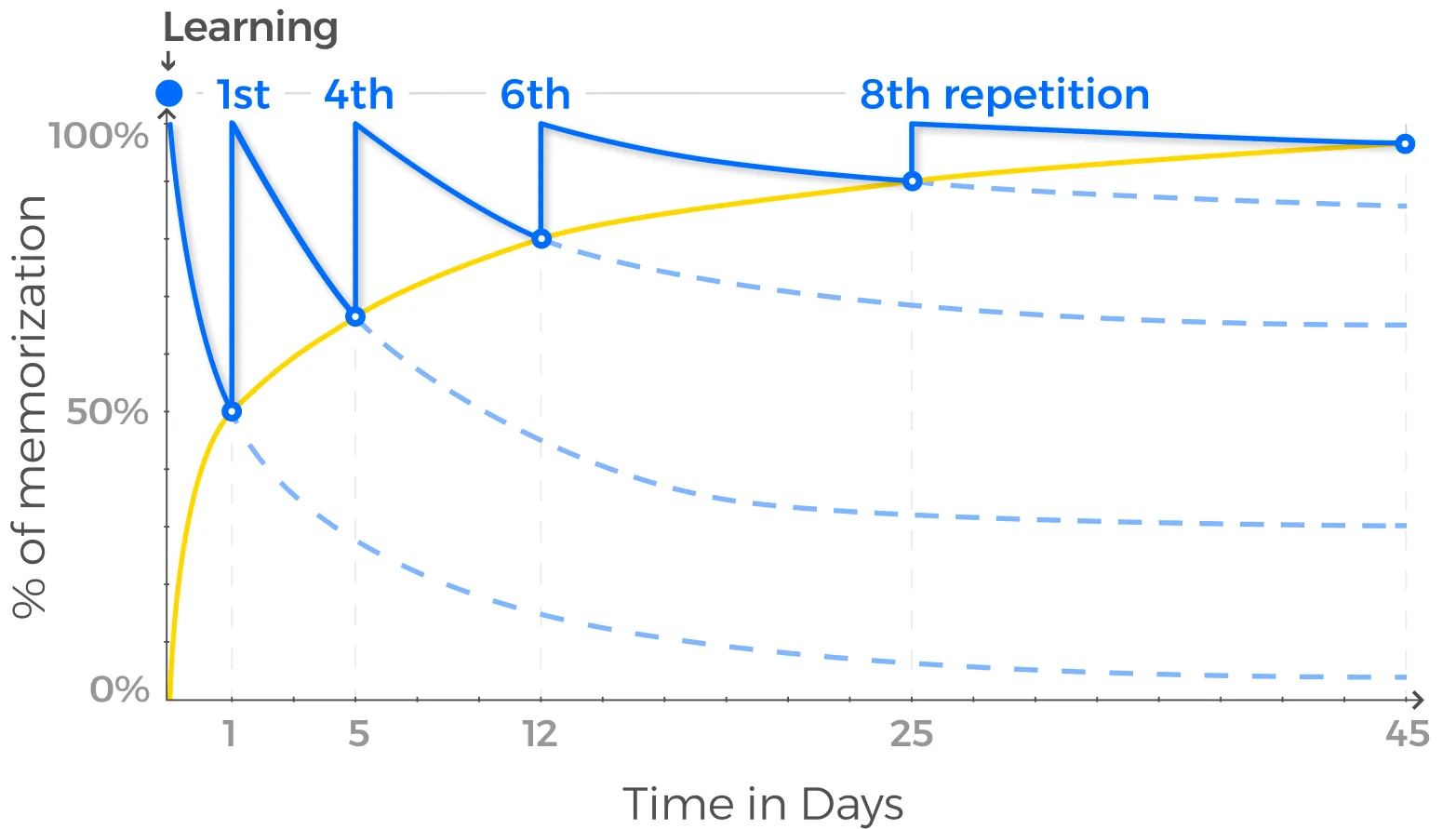
You can see that the memory maintains its retention because we're recalling it overtime.
This "spacing out" is determined by an algorithm. Probably the most famous one being the SM-2 from Supermemo. Anki also uses SM-2. Although, they use their own modified version of SM-2, and recently they added FSRS algorithm which is the latest and greatest algorithm out there that supposedly works better than the older algorithms.
If you want to compare which algorithm works best, the team from FSRS made a benchmark comparing various algorithms. I personally stick to FSRS because I do believe it works better then the alternatives :)
How to start using it
Unfortunately, since this is just a high level overview of what these things are, I won't include details on how to get started, there are already TONS of resources out there. There are dozens of Youtube videos on how to setup Anki, setting up your decks, setting up the scheduler optimizer, etc.
However, I will give a brief explanation over some terminologies that I will use later on so that you get the basic idea of what SRS is.
Flashcards
In SRS, the thing you want to remember are collected in the form of "cards", also known as "Flashcards". The front of the card will be the question / prompt, and at the back of it is the answer. This is based on oldschool method, most people use digital version like Anki and many other apps, but the concepts stay the same.
You can have anything for your cards, as long as it helps you to memorise. For example, if I want to remember Japanese nouns, I would put an image at the front and the answer with relevant details (readings, kanji, etc) at the back.
You can also put various types of cards, such as:
- Basic: The basic question/answer card, not much to it.
- Cloze: The one where you have to choose correct answer between multiple options.
- Image occlusion: You are given partial image and you have to correctly memorise the full image.
- ...and many more, you can be as creative as you want!
Decks
Now that you know what flashcard is, you will find the term "deck". A deck is basically a group of cards. You can have multiple decks for various topics. For example, I have Japanese N3 Grammars deck, Japanese N3 Vocabularies deck, etc.
Simply think of it like folders, but specifically for flashcards.
Review
Like I mentioned earlier, memorising things effectively is pretty much about reviewing / recalling things at the correct time. Although, reviewing shouldn't be just about reading flashcards, you should be able to rate how difficult it is to recall because it will affect how the algorithm calculate the next schedule.
Remember, this is not a test, you don't need to act like you remember if you don't. Press that red button that says "again" or that other button that says "> 15 mins" if you really need to, no shame in doing that :)
What does a typical SRS session looks like?
Open deck -> See a card -> Try to recall -> Show answer -> Rate difficulty (again, easy, hard, forgot).
TBD === Please continue from here :)
Few things to note about SRS
Like most things in life, SRS is not a solution that automagically makes you remember things instantly, it's just a tool. How well a tool works really depends on how you use it. Use it sparingly and all you're doing is just clicking buttons without actually memorising anything.
Repetition is not the same as understanding
Just reviewing cards won't get you anywhere, you need to put an effort to understand.
The Smart Way to Remember
- Use tools or systems that track what you’re about to forget.
- Show up consistently, review just enough.
- It saves you time, boosts memory, and keeps you sane.
Wrap-Up / Personal Touch
- “This method helped me stop forgetting words like 猫(ねこ)and actually use them.”
- “If you’re struggling with memory in language learning, the timing of review might be your missing piece.”
- Optional: “That’s why I’m building a tool that helps with this (MochiMemo plug?).”
If you don't see any comment section, please turn off your adblocker :)